 Bulgaria
  Greece
  Turkey
  Romania
  Serbia
  N. Macedonia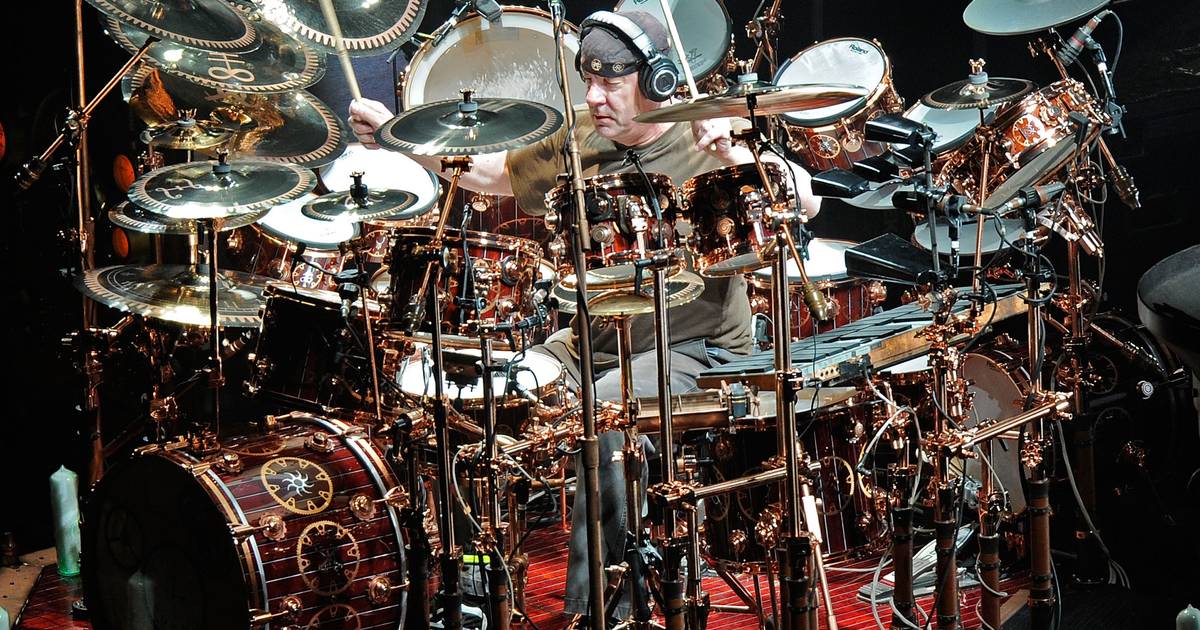
Neil Peart is perhaps the most respected drummer in the history of progressive rock. He doesn't just play drums – he composes through them. For him, the drum kit is not a rhythmic instrument but an entire orchestra of sounds and ideas. While many drummers focus on speed or power, Peart focuses on structure, intellect, and emotion.
Neil Peart was born in 1952 in Hamilton, Ontario, Canada. He joined Rush in 1974, replacing original drummer John Rutsey. This turned out to be one of the most important moments in rock history. From that moment, Rush became one of the most influential trios in history – Geddy Lee on bass and vocals, Alex Lifeson on guitar, and Neil Peart behind the drums.
Before Peart, drums in rock were often perceived as rhythmic support. He changed that completely. With him, the drums are a lead instrument. His drum parts are so complex and well-constructed that they can often be performed as standalone compositions. He is one of the first drummers to use huge kits with multiple toms, cymbals, and percussion to create maximum sonic variety.
Peart's style is built on several key elements: complex polyrhythms, incredible limb independence, exceptional control over dynamics, melodic thinking, and the ability to build long, logically connected drum phrases. He thinks like a composer, not a performer.
His technique is one of the most complete in history. He uses a combination of different grip styles, including traditional grip and matched grip. He has exceptionally developed coordination – he can perform completely different rhythms with all four limbs simultaneously. This allows him to create polyrhythmic structures that sound like music on multiple levels at once.
His sound is one of the most recognizable in rock music – clean, precise, with enormous dynamics and exceptional clarity. He uses Ludwig, Tama, and Drum Workshop kits with Zildjian cymbals. One of his most famous features is the use of a huge number of toms and cymbals, giving him an almost endless palette of sounds.
Among his greatest performances are YYZ – a true lesson in polyrhythms and coordination; Tom Sawyer – with the iconic cymbal intro and complex rhythms; La Villa Strangiato – one of his most complex performances, with multiple tempo and time signature changes; The Spirit of Radio – a perfect balance between power and precision; and 2112 – an epic composition where the drums tell the story themselves.
Neil Peart had a huge influence on generations of drummers – from progressive rock to heavy metal. Almost every modern drummer who strives for complexity and musicality has been influenced by him. His approach to the drums – as a compositional instrument – changed the very perception of what a drummer can do.
For objectivity – Neil Peart is not as physically powerful as John Bonham and not as explosive as Keith Moon. His strength is in intellect and structure. Some critics think his music is sometimes overly complex, but that's precisely what makes him unique.
If John Bonham is an earthquake, Keith Moon is lightning, Ginger Baker is a storm, and Ian Paice is a racing car, then Neil Peart is a cathedral – built with mathematical precision, but filled with soul and grandeur. He is the man who showed that drums can be intellectual art.